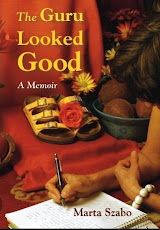
Several months ago, I started reading Marta Szabo’s on-line story, The Guru Looked Good. She was describing her ten year involvement with a spiritual group called Siddha Yoga. I had also spent time with this group and I was hoping to have my own observations and feelings validated. I wanted to gain insight into my own cult mentality, and I wanted to know that leaving had been the right decision. I didn’t realize the effect this story would have on me.
The Guru Looked Good was a series that delivered one or two new chapters every week. I was captivated after finishing the first few chapters. The story was so familiar it was like reading about my own experience. I was particularly taken with the description of the early morning chant, “The Guru Gita.” I had sung this devotional song every morning for years and it had inspired me and filled me with awe, purpose and bliss. I remembered those feelings now and a deep longing for this ritual was reawakened. Like a child whose best friend has moved far away, I became quiet and wistful. “I really do miss the chanting sometimes,” I sighed.
That night I awoke possessed by visions of Siddha Yoga. As I watched the intruding images unfold, I wavered between longing and repulsion, gladness and fear. I groaned and turned again to my other side, but no amount of turning could stop this stream of memories: Once again I was sipping hot chai in the Amrit. Once again I was reverently walking past picture after picture of the gurus. Once again I was in the meditation hall basking in exalted stillness, watching the devotees sway from side to side. Once again I was singing Shri Krishna, Govinda, my boisterous participation bringing me to exquisite ecstasy. “Christ,” I murmured. “I thought I was past all this.”
I was depressed for two days. Like a drunk divorcee, I forgot my reasons for leaving Siddha Yoga and longed for the past . . . a past where everyday started out perfectly and I was surrounded by a loving community. . . a time when all my questions had answers and I felt protected and pure and holy and . . .
Now take a deep breath and think back to what it was really like.
The truth was I often felt uncomfortable at Siddha Yoga. I always felt that I had questions that I couldn’t ask and topics that I couldn’t discuss. In the beginning, my conversations were often interrupted by others and replaced with stories about Gurumayi, Baba, or Nityananda. I often felt there was a competition going on between the devotees over who had greater access to the guru; and everything that did or didn’t happen was attributed to her grace. One day a woman questioned me about my job and financial situation. She shook her head disdainfully and commented that it was a wonder I could support myself at all. I found this remark rude and superficial, but I let it slide. After all, I did love the chanting.
Indeed, it was through the chanting that the good devotee was born. The more I chanted the easier life seemed to get. Chanting usually made me high. The higher I got the easier it was to ignore the red flags and accept the new doctrine without question. The old me, or the free thinker, got quieter and quieter until there was only the occasional protest.
The next day things were back to normal. Encouraged, I looked forward to the next installment of Szabo’s story. What I soon learned, however, was that every week after reading the next chapters, I would once again spiral into an internal struggle between the good devotee and the free thinker. The two of me battling old fears and superstitions that I thought I had resolved.
“Oh for heaven sakes, you’ve gotten everything you’ve asked for, stop complaining,” admonished the good devotee.
“Just leave, already. Call a cab. Take a bus. Get the hell out of there!” yelled the free thinker.
This constant conflict began to wear on me and I wondered
if I should be reading this story at all. “Maybe this is bad for me,” I mused. “Or maybe this is good because it’s helping me exorcise the cult demons.” There had been rumors going around that the Siddha Yoga gurus had practiced black magic. “Could this author be working with my old guru and this story be a form of black magic?” My paranoia continued:
“What the hell?”
“It’s good, it’s like Tantra.”
“You mean Black Tantra?”
“No, no, it’s okay, I think.”
“Okay, I’m not going to read it anymore.”
“Well, maybe just one more time.”
“Oh, hell, I just don’t care, really.”
“Oh, really?”
I couldn’t stop reading the story. I was on the train and I didn’t want to get off. Through it all the yearning for the morning chant continued. At different times during the week I’d find myself going to the Siddha Yoga website. I didn’t really know what I was looking for. I would just browse through the pages mindlessly, eventually leaving the website feeling empty. One day I went to the group’s virtual bookstore and clicked on the morning chant CD. Seeing the link for an audio sample, I figured, “What the hell,” and clicked the play button.
As the first strains of the “Guru Gita” began, my eyes widened in disbelief. The guru’s voice, which I had so often pined for, was now an assault on my senses. I winced as a discordant bellow roared at me through the computer speakers, my hands flying up to cover my ears. “Holy crap, this sounds bloody awful,” I cried clicking the stop button. “I don’t remember this sounding so bad.” I sat in shock and confusion as I realized my eardrums were actually hurting. A few moments latter I started to feel tired, even a little dizzy. I shuffled off to my bedroom and laid down on the bed.
Within moments, a faintly buzzing energy engulfed me in a heavy blanket of stillness. From the tips of my toes, I could feel a wave of euphoria spreading up and through my entire body. From far away I could hear myself exclaiming, “Uh-oh, I’ve been zapped.” But I was too tired to fight it. All the debating and internal struggling had worn me out. I was ready to feel the bliss of no-feeling. I was aware of the narcotic quality of my experience, but I didn’t care. I took a deep breath and surrendered to the delicious numbness that saturated my being.
I lay there for an hour. When I finally got up, I shrugged. “Religion, the opiate of the people.” I mumbled.
The rest of my day had a dreamlike aspect to it. I floated from one activity to the next, never entirely engaged and quite content. That evening, I noticed myself smiling inappropriately as I watched the evening news, the parade of world tragedy unable to reach me through my anesthesia. From far away, my mind chided, “You’re still stoned. Snap out of it. Get back to reality.”
“Reality?” I countered. “In the last five years I’ve lost my parents, my health, and my religion. Just how much reality can a person take?”
I was euphoric for the next week. It was during this time that I purchased The Nectar of Chanting, which contained the “Guru Gita.” “I’ll just sing it a cappella,” I told myself. “I won’t be singing it to a guru; I’ll be singing it to God.” By the time the book arrived my rapture had worn off. I reluctantly decided to give the chant one more try. Opening the book I was careful not to look at the guru pictures in the front of the text, and proceeded to sing it a cappella. I was surprised and pleased that I remembered the intonation, but in the end the experience left me tired and flat. It just wasn’t happening anymore. The mindfulness practices I’d been doing were really much better for me—more clarity, less baggage. I thought about the money I had just spent on the book. Jeez, I’m such a sucker.
But that was not the end of it. That night in my dreams I heard the morning chant—and not just the a cappella version. Gurumayi, the swamis and the devotees were all singing, as the tambura and harmonium droned in the background. Struggling to wake up, I mustered all my mental strength and ordered, “Just say no! No, no, no, no, no!” Amazingly enough, the ruckus stopped and I rolled over and returned to sleep. Several hours later it happened again. “What have I done,” I moaned. The good news was that the just say no strategy was working, but only for the short term. I had to repeat it two more times before morning, and exhausted, I got up determined to stop this craziness once and for all.
I picked up the chant book, trying to decide what to do with it. In the process the book fell open and I found myself looking at the pictures of the gurus. The first picture of Nityananda made me smile. The second picture of Muktananda looked insincere, and the third picture of Gurumayi seemed severe, distant and icy. I had never liked these last two photos, and I had never understood why they were in the book. I had always made a point of not looking at these two pictures because on some level they disturbed me. “Red flags everywhere,” I muttered. I continued to stare intensely at the photos and thought about the rumors of sorcery. “Are these the faces of two black magicians?” I asked.
A tiny point of pain began contracting in my solar plexus and I held my breath as the sensation grew stronger migrating upwards towards my throat. As my chest began to tighten I laid The Nectar of Chanting on the desk and ripped the guru photos from the book. “But what do I do with these photos? I wondered. “What is the proper procedure? Do I bury them, burn them, sprinkle them with holy water?”
Just breathe. The important thing is don’t let these people scare you.
I took a deep breath, and then another, and another. I watched my breath return to normal and continued my awareness of the breath until all the fear and anxiety had dissolved into nothing. Once again I looked down and saw I was holding two pieces of paper. I held two photos of two people who had, according to many accounts, been manipulative and unethical; two human beings who had betrayed the trust of many innocent people. I shrugged and reconsidered, “Maybe I’ll need these for future reference.”
I slipped the portraits back into the book and headed for the walk-in closet. On the middle shelf was a box labeled cult studies. It was a moving box full of books, CDs, DVDs, hand cymbals, deity statues, incense, recipes, and pictures. These objects were like pieces of a dream, a dream I was deconstructing, one delusion at a time. I dropped the chant book into the box, and strode into the next room. Closing the closet door, I smiled. The spell was broken.